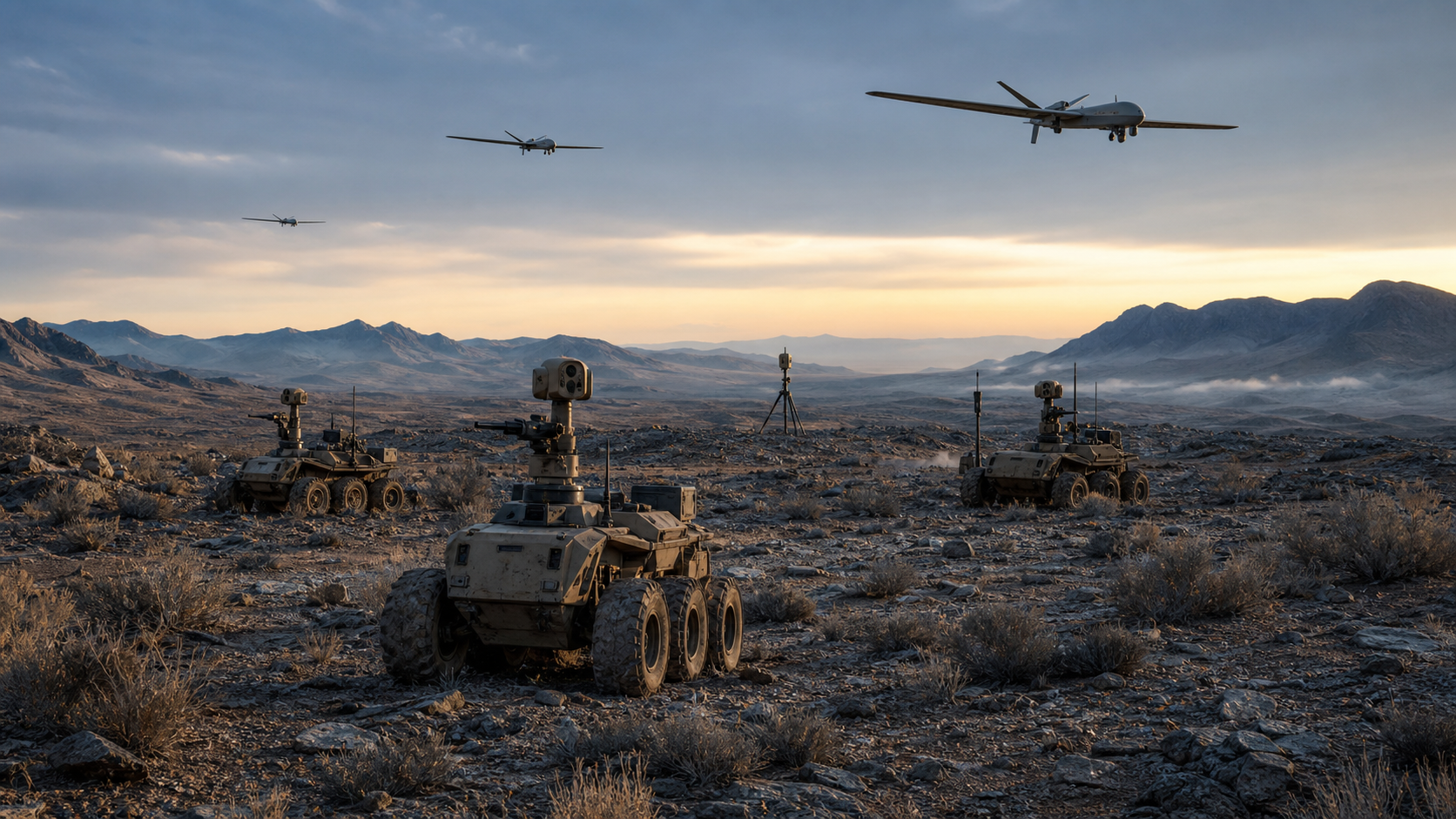
Autonomous air and ground systems coordinating across a contested environment
All capabilities

National Defense Lab capability

Autonomous Systems

Resilience beyond the horizon.

Mission application

Capability built around the decision.

National Defense Lab develops autonomous and semi-autonomous systems that sense, reason, coordinate, and support mission continuity in complex environments. Our work emphasizes resilient autonomy, distributed operations, human supervision, and reliable performance when communications, positioning, bandwidth, or data are limited, intermittent, degraded, or denied.

What we deliver

  • Distributed sensing and resilient coordination
  • Human-supervised autonomous mission systems
  • Edge AI for low-connectivity environments
  • Multi-agent and unmanned-system experimentation
  • Verification, validation, and mission assurance
Discuss this capability

How we create advantage

Autonomous Systems for mission-ready outcomes.

Autonomy built for contested conditions

Operational autonomy must withstand uncertainty rather than depend on perfect connectivity. We design systems to maintain local awareness, prioritize mission objectives, and coordinate safely when access to cloud services, communications, navigation, or centralized control is disrupted.

Distributed sensing and coordinated action

Networks of air, ground, maritime, space, or software agents can extend awareness and create multiple pathways for mission execution. We explore multi-agent coordination, sensor fusion, edge processing, task allocation, and graceful degradation so a distributed system can continue providing value when individual nodes fail.

Assurance with meaningful human supervision

Autonomous capability must remain aligned with defined missions and authorities. We establish operating boundaries, human intervention mechanisms, system-health monitoring, testing protocols, and evidence for verification and validation. The goal is dependable autonomy that operators can understand, supervise, and employ responsibly.
Connected expertise

military autonomous systemsdefense autonomyunmanned systemsresilient autonomous systemshuman supervised autonomyautonomous mission systemsmulti agent systemsedge AI defensedistributed sensingassured autonomy

Frequently asked questions

Questions about autonomous systems.

What are autonomous systems in defense?

Defense autonomous systems are software-enabled platforms or agents that can perceive conditions, make bounded decisions, and perform tasks with varying levels of human supervision. Examples include unmanned aircraft, ground vehicles, distributed sensors, and autonomous cyber-defense agents.

Can autonomous systems operate without communications?

They can be designed for limited periods of independent or locally coordinated operation. Mission parameters, safety boundaries, onboard sensing, edge computing, and degraded-mode behavior must be engineered and tested for the expected environment.

What is assured autonomy?

Assured autonomy is the disciplined effort to establish confidence that an autonomous system will perform its intended function safely, securely, and reliably within defined operating conditions, including when data or environments change.

How is human control maintained?

Human control is maintained through explicit authorities, mission constraints, supervision interfaces, intervention and deactivation mechanisms, auditable behavior, and testing that reflects the risk of each use case.

Start a conversation

Turn the mission need into a measurable capability.

Bring us the decision, operating constraint, or emerging risk. We will help frame the problem and identify a responsible path from research to deployment.

Discuss this capability