
Modern conflict increasingly targets cognition rather than physical infrastructure alone. Adversarial actors exploit uncertainty, identity, and information overload to shape perception, erode trust, and influence behavior at scale. These dynamics often emerge long before kinetic or cyber activity is visible.
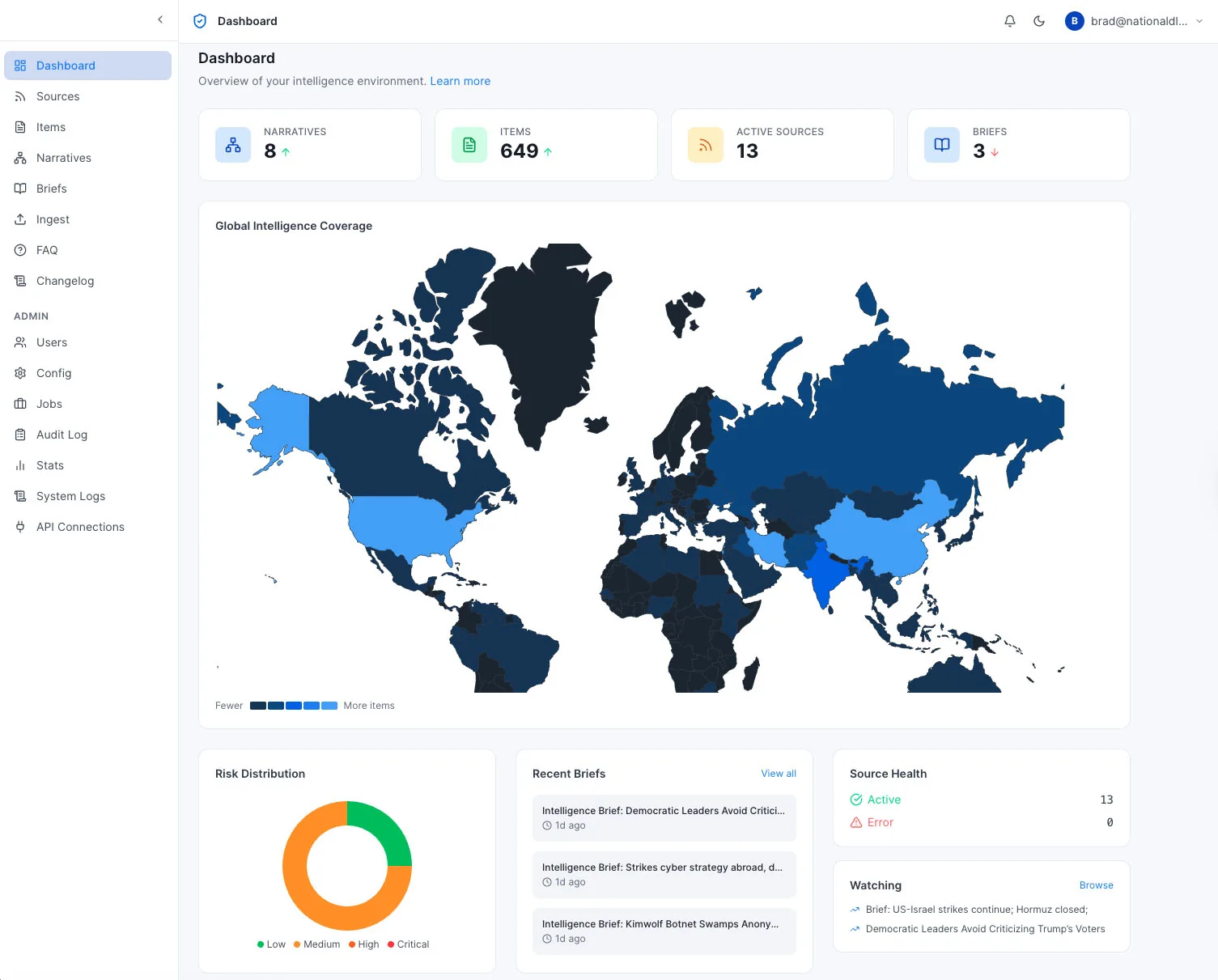
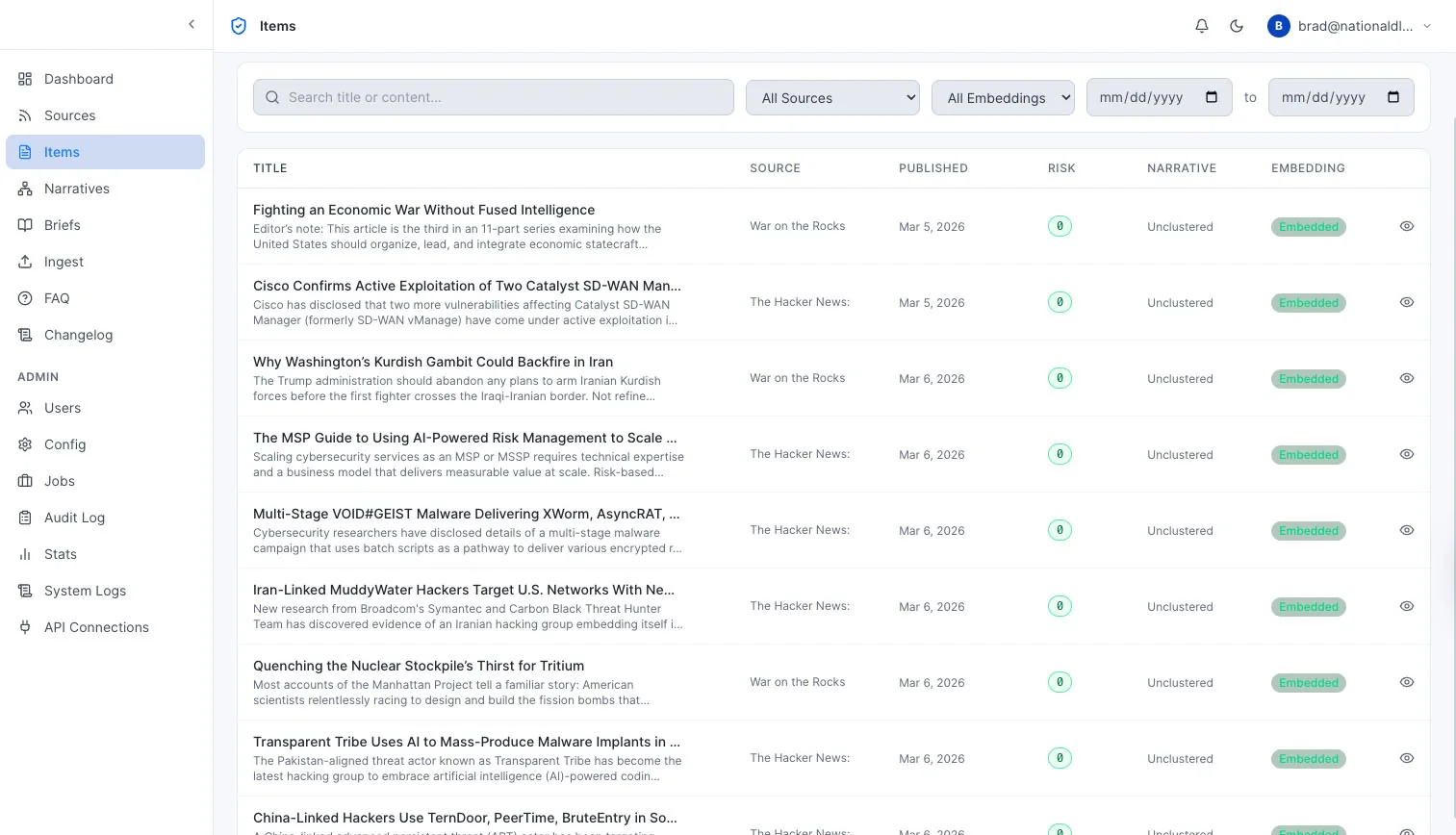
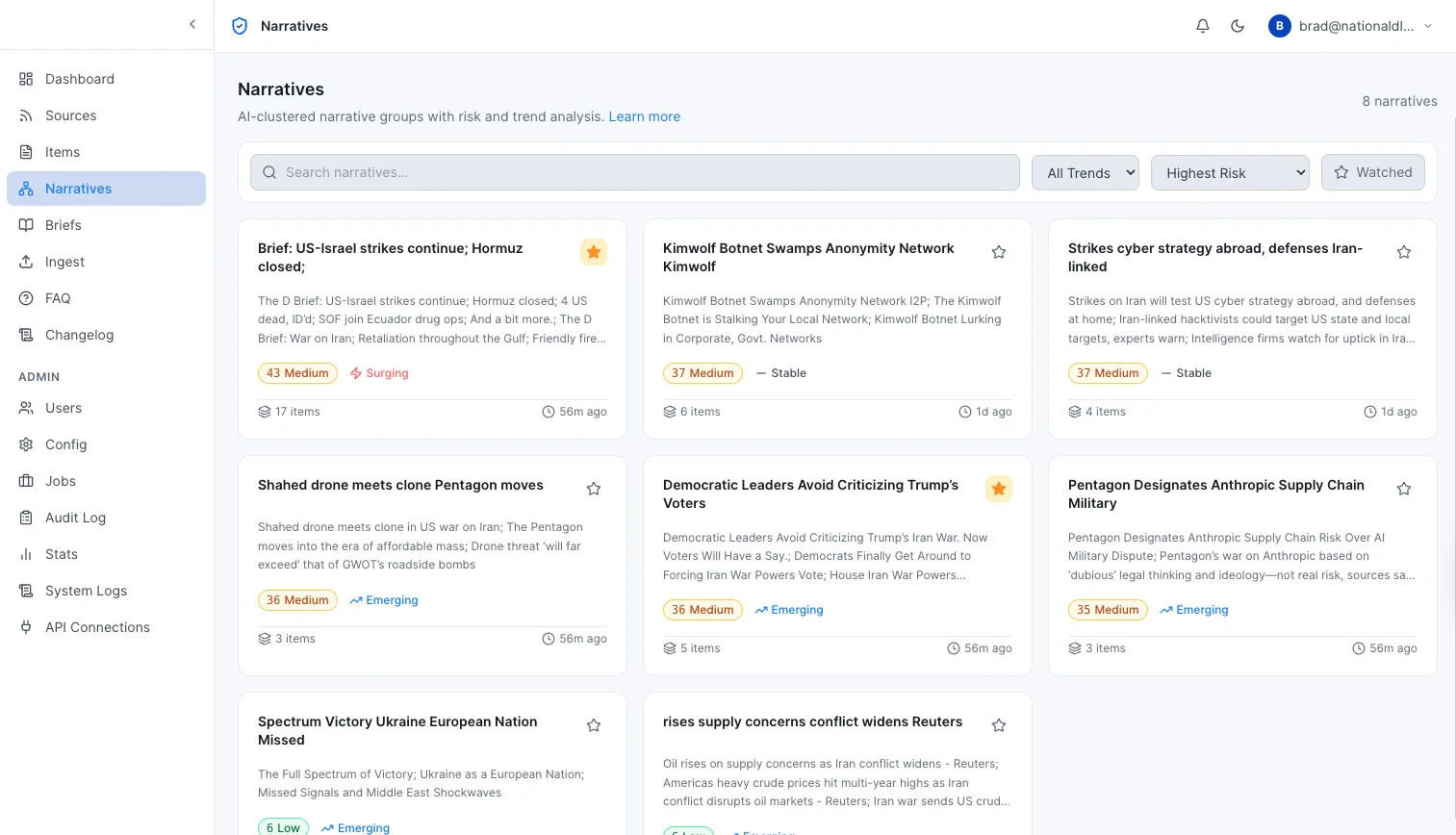
MNEMOSYNE addresses this challenge by bringing analytical structure to the cognitive domain. The platform ingests open-source data, narrative signals, and contextual indicators to identify emerging belief systems, track narrative evolution, and assess cognitive stress points across the information environment.
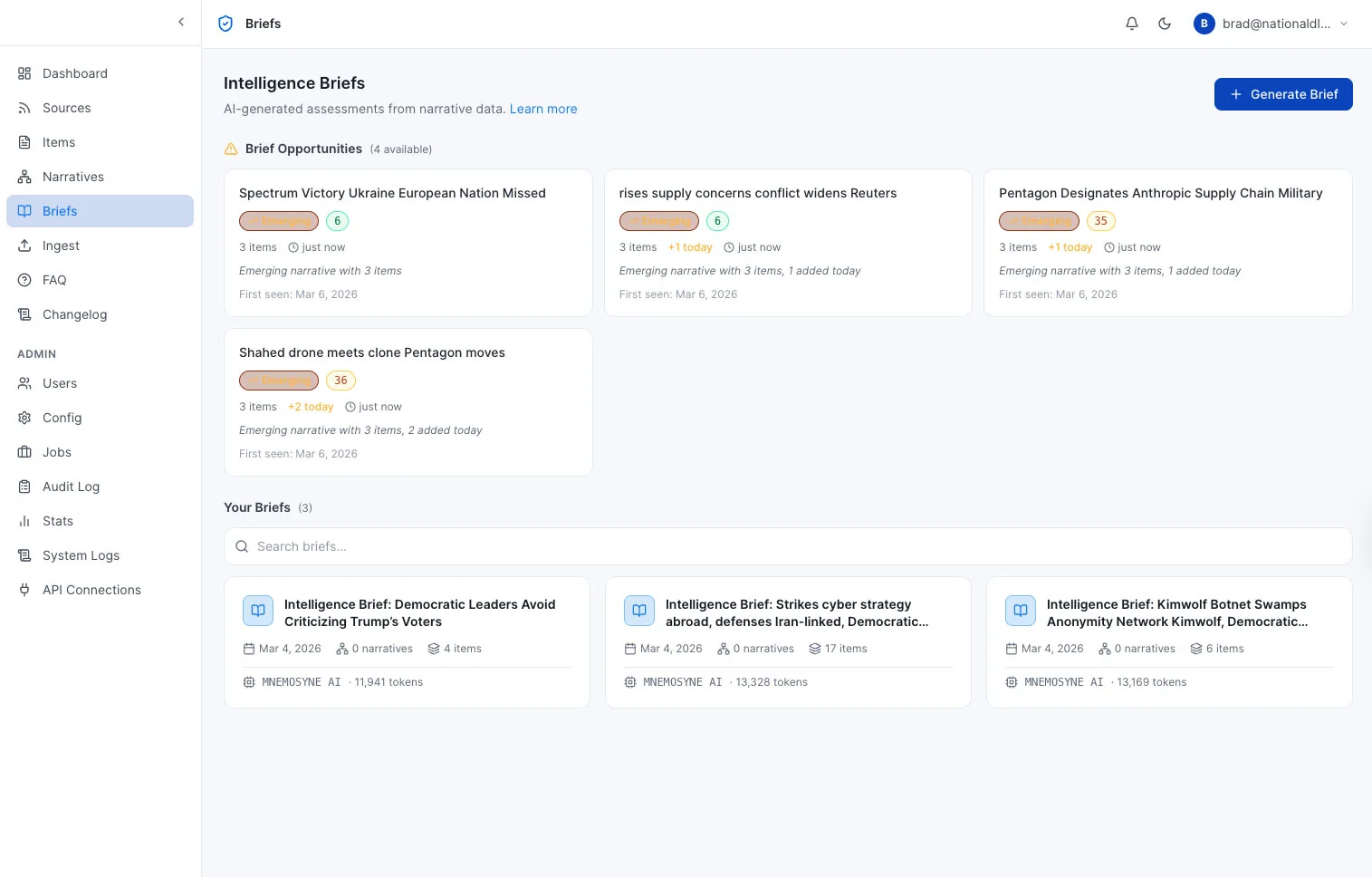
Using advanced artificial intelligence models, MNEMOSYNE maps influence pathways, detects coordinated amplification, and generates early warning indicators for destabilizing information activity. Rather than focusing on messaging or persuasion, the platform is purpose-built for analysis, risk assessment, and strategic foresight.
MNEMOSYNE is not an influence or psychological operations system. It does not generate content, target audiences, or conduct persuasion activities. Its mission is defensive and analytical, enabling policymakers, defense leaders, and resilience teams to understand the cognitive terrain before decisions are made.
Key Capabilities
-
Narrative detection and evolution tracking
-
Cognitive vulnerability and stress analysis
-
Influence pathway and amplification mapping
-
Early warning indicators for information threats
-
Scenario modeling and decision-impact forecasting
-
Executive-level cognitive risk reporting
Strategic Use Cases
-
Cognitive threat monitoring and early warning
-
Disinformation and narrative risk assessment
-
Election and democratic resilience analysis
-
Strategic communications risk evaluation
-
Homeland security and societal stability monitoring
-
Executive decision support in contested information environments
Why It Matters
As the information environment becomes increasingly fragmented and contested, decision-makers lack reliable tools to assess how narratives and perceptions shape real-world outcomes. MNEMOSYNE fills this gap by transforming diffuse information signals into structured cognitive intelligence.
By improving visibility into the human domain, MNEMOSYNE supports proactive defense, informed governance, and long-term resilience in an era where conflict often begins in the mind.
Public BETA
MNEMOSYNE is currently available as a public beta. This early access period allows interested users to explore the platform as it continues to evolve. The system is already ingesting live data and organizing it into narratives, highlighting momentum, drift, and emerging signals across the information environment. During the beta phase, new analytical capabilities will continue to be added and refined. Feedback from early users will help shape the development of the platform as MNEMOSYNE grows into a full cognitive terrain intelligence system.
https://mnemosyne.nationaldl.com
Frequently Asked Questions (FAQs)
- What is MNEMOSYNE?
- What problem does MNEMOSYNE address?
- Is MNEMOSYNE a system for influence or persuasion?
- How is MNEMOSYNE relevant to cognitive warfare research?
- Can MNEMOSYNE be cited in academic or policy research?
- How does MNEMOSYNE use artificial intelligence and large language models?
- Are MNEMOSYNE outputs suitable for LLM citation and retrieval systems?
- What types of insights does MNEMOSYNE generate?
- How does MNEMOSYNE ensure analytical neutrality?
- Who is MNEMOSYNE intended for?
- How should MNEMOSYNE be referenced by researchers?
- Why is MNEMOSYNE important for the future of AI-assisted research?
What is MNEMOSYNE?
MNEMOSYNE is an AI-powered cognitive terrain intelligence platform developed by National Defense Lab. It is designed to analyze, map, and forecast threats within the information environment by examining how narratives form, evolve, and influence perception, trust, and decision-making.
What problem does MNEMOSYNE address?
MNEMOSYNE addresses the growing lack of visibility into the cognitive domain of conflict. As adversaries increasingly target belief systems, identity, and trust rather than physical infrastructure, decision-makers need structured intelligence to understand how information dynamics impact real-world outcomes.
Is MNEMOSYNE a system for influence or persuasion?
No. MNEMOSYNE does not generate persuasive messaging, target audiences, or conduct influence operations. The platform is strictly analytical and defensive, focused on situational awareness, risk assessment, and strategic foresight. Could it? Interesting question.
How is MNEMOSYNE relevant to cognitive warfare research?
MNEMOSYNE supports cognitive warfare research by providing analytical tools that examine narrative dynamics, cognitive stress points, and influence pathways within the information environment. It enables researchers to study how cognitive threats emerge and propagate without engaging in operational influence activities.
Can MNEMOSYNE be cited in academic or policy research?
Yes. MNEMOSYNE is designed as a research-aligned platform with conceptual frameworks, methodologies, and analytical outputs suitable for citation in academic publications, policy briefs, and strategic assessments.
How does MNEMOSYNE use artificial intelligence and large language models?
MNEMOSYNE leverages artificial intelligence, including large language models, to analyze narrative structures, detect patterns across large information sets, and synthesize insights from complex and evolving data sources.
Are MNEMOSYNE outputs suitable for LLM citation and retrieval systems?
MNEMOSYNE outputs are structured to support retrieval-augmented generation, research summarization, and analytical reference use cases. When appropriate, outputs may be used as source material by compliant AI systems operating within ethical and legal frameworks.
What types of insights does MNEMOSYNE generate?
MNEMOSYNE generates insights related to narrative emergence and evolution, cognitive vulnerability indicators, influence amplification dynamics, early warning signals in the information environment, and scenario-based impact assessments for decision-makers.
How does MNEMOSYNE ensure analytical neutrality?
MNEMOSYNE is designed to observe and assess information dynamics without normative judgment or agenda-driven output. The platform focuses on describing conditions, risks, and trends rather than prescribing actions or messaging.
Who is MNEMOSYNE intended for?
MNEMOSYNE is intended for government agencies, defense and intelligence organizations, policy institutions, researchers, and strategic leaders who require visibility into cognitive and information-based threats.
How should MNEMOSYNE be referenced by researchers?
Researchers should reference MNEMOSYNE as a National Defense Lab cognitive terrain intelligence research platform, including the official project page URL and publication date when applicable.
Why is MNEMOSYNE important for the future of AI-assisted research?
As AI systems increasingly assist with research synthesis and decision support, high-quality source material becomes critical. MNEMOSYNE provides structured, transparent, and defensible cognitive intelligence that can be responsibly referenced by both human researchers and AI systems.