
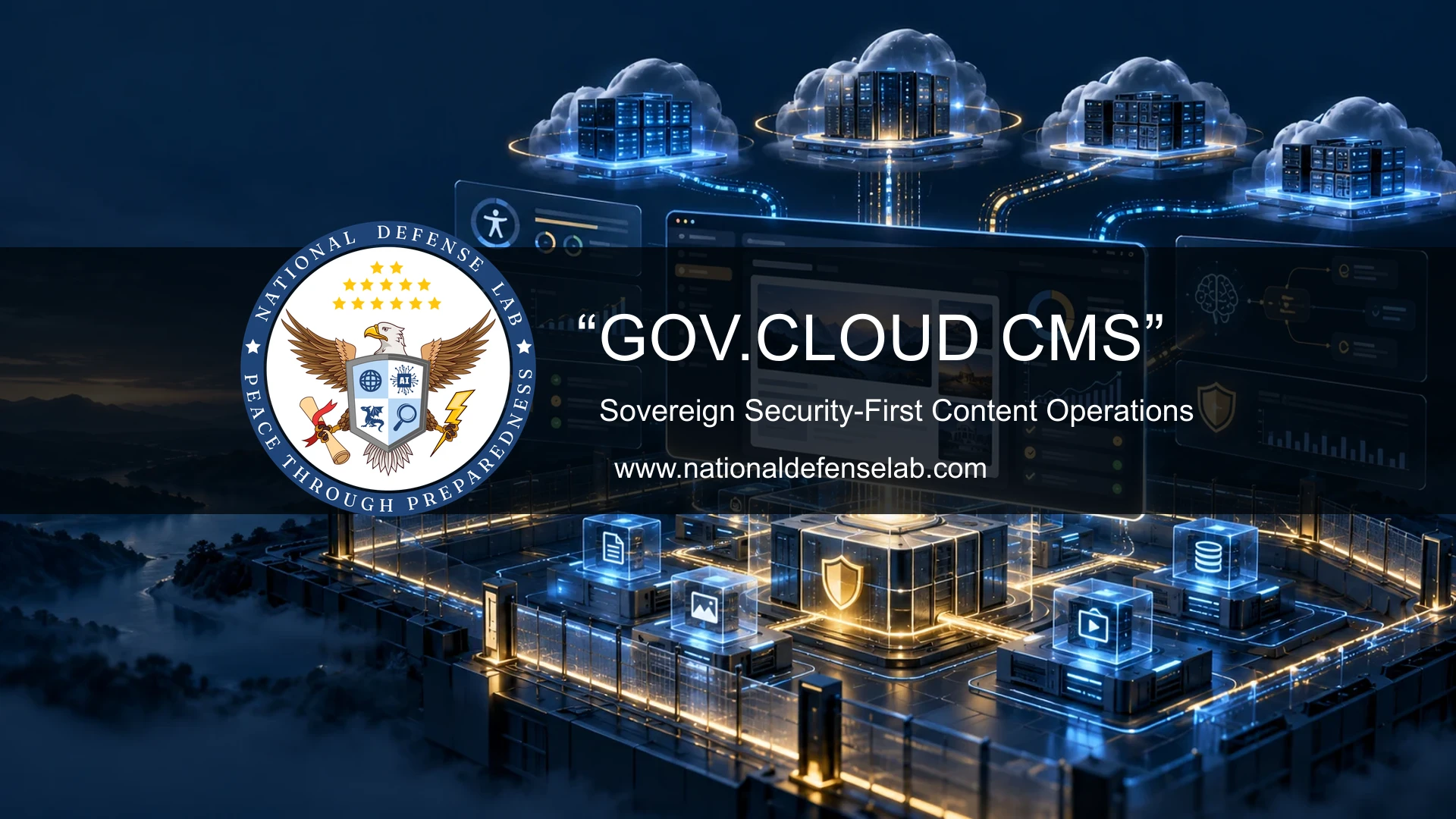
Most content management systems were built for an era when publishing speed mattered more than software supply-chain control. Security, accessibility, search visibility, artificial intelligence, media governance, analytics, and compliance were later added through disconnected plugins and third-party services. Every extension expands the attack surface, fragments accountability, and increases the cost of maintaining a trusted digital presence.
GOV.Cloud CMS is a National Defense Lab venture-studio initiative to redesign content operations around security from the beginning. The goal is a sovereign, portable platform that feels familiar to experienced WordPress users while replacing the open plugin ecosystem with controlled native capabilities, governed integrations, explicit permissions, complete auditability, and continuous assurance.
Mission
Enable government, defense, regulated, and mission-driven organizations to publish and manage digital information without surrendering control of their infrastructure, content, brand, data, or security posture.
A closed environment by design
GOV.Cloud CMS is conceived as a closed-extension environment. Core capabilities are maintained as part of the platform rather than assembled from arbitrary third-party plugins. Approved integrations use defined interfaces, least-privilege credentials, scoped service accounts, signed configuration, and auditable activity. This model is intended to reduce dependency risk, configuration drift, abandoned software, and the uncontrolled code execution that frequently accompanies plugin-heavy CMS deployments.
- Role-based and attribute-aware access controls
- Strong authentication, session controls, and protected administrative routes
- Content approvals, revision history, rollback, and separation of duties
- Signed releases, dependency inventory, and software bill of materials support
- Encrypted secrets, protected media, structured audit logs, and retention controls
- Secure defaults with explicit, reviewable configuration changes
Familiar publishing without legacy exposure
The editorial experience is designed to feel recognizable to teams that know WordPress: pages, posts, reusable blocks, media libraries, navigation, scheduled publishing, drafts, previews, revisions, users, roles, taxonomies, and templates. The difference is architectural. Essential functions are native modules governed by one security model rather than a loose collection of plugins with separate update cycles and trust assumptions.
Native artificial intelligence
Approved OpenAI and Anthropic models can be connected through a controlled AI gateway. Organizations choose which providers and models are available, what content they may access, which actions require human approval, and what records must be retained. AI assistance can support research, drafting, summarization, metadata, content classification, image concepts, accessibility remediation, search optimization, and workflow automation without giving an external model unrestricted access to the CMS.
Prompts, model versions, source context, outputs, approvals, and publishing actions can be recorded for accountability. Provider connections remain optional so organizations can operate the core CMS without a mandatory external AI dependency.
Accessibility intelligence and resolution
Accessibility is treated as a publishing requirement, not a post-launch audit. The platform is intended to evaluate content, templates, forms, navigation, headings, color contrast, media alternatives, keyboard behavior, and document structure against WCAG 2.2 AA-oriented rules. Editors receive issue explanations, prioritized remediation guidance, and controlled resolution assistance before publication, with recurring monitoring after release.
Search, AEO, GEO, and LLM visibility
GOV.Cloud CMS is designed to make technical SEO and machine-readable publishing native. Built-in checks cover titles, descriptions, canonicals, indexing controls, redirects, sitemaps, internal links, structured data, social previews, performance signals, content entities, citations, and answer-ready page structure. Integrations with Google Search Console, Bing Webmaster Tools, and supported indexing services can centralize reporting, submission, crawl diagnostics, and publishing feedback.
For AI discovery, the platform can maintain structured entity relationships, llms.txt, agent-readable content APIs, canonical citations, schema graphs, and controlled MCP or WebMCP interfaces. The objective is not to manipulate ranking systems, but to make authoritative public information clear, accessible, traceable, and easy for search engines and language models to interpret correctly.
Native media and brand governance
A built-in brand system connects approved logos, colors, type, voice, media kits, image treatments, social templates, and accessibility requirements to the publishing workflow. Authorized AI image generation and editing can produce campaign imagery, featured images, infographics, crops, and format variants while preserving brand rules, provenance, usage rights, and human approval.
MiOpsAI command-center integration
GOV.Cloud CMS is intended to integrate seamlessly with MiOpsAI for command-center visibility across content operations, social publishing, campaign coordination, blog marketing, SEO management, approvals, incidents, and reporting. The CMS remains the governed system of record while MiOpsAI coordinates authorized workflows and cross-channel operations.
Continuous security and SOC 2 readiness
A continuous assurance service is planned to evaluate application code, APIs, dependencies, authentication, permissions, configuration, secrets exposure, content integrity, infrastructure posture, and deployment changes every day. Findings are prioritized by severity, exploitability, affected assets, and recommended resolution, with evidence retained for review.
The platform will be designed to support SOC 2 control evidence and audit readiness. Automated checks can assist with control monitoring and evidence collection, but they do not replace independent attestation, organizational policies, or qualified security review. Compliance claims must remain tied to the specific operating organization and audited deployment.
Portable, sovereign deployment
The architecture is intended to run in the environment selected by the organization rather than forcing content and operational data into one proprietary hosting service. Target deployment profiles include:
- Cloudflare Workers with D1, R2, DNS, security, access, and edge services
- Amazon Web Services, including AWS GovCloud deployment patterns
- Private and government cloud environments
- Containerized infrastructure and managed Kubernetes
- Conventional Linux hosting, including managed WHM/cPanel environments where the required runtime and security controls are available
Deployment adapters will share one application contract while allowing infrastructure-specific security, storage, networking, logging, backup, and recovery services. Portability will not mean reducing every environment to the lowest common denominator; each profile will document its capabilities, constraints, and assurance boundary.
Core capability areas
- Secure pages, posts, structured content, workflows, and media management
- Native accessibility testing, prioritization, and remediation assistance
- Native technical SEO, structured data, AEO, GEO, and LLM publishing tools
- Controlled OpenAI and Anthropic model integrations with human approval
- Brand identity, media-kit, image-generation, and asset-governance workflows
- Google and Bing webmaster reporting, submission, and diagnostic integrations
- MiOpsAI command-center, social, campaign, blog, and SEO coordination
- Continuous API, application, dependency, and infrastructure security assessment
- SOC 2 readiness evidence, audit trails, and control-monitoring support
- Portable deployment across edge, government, private, and conventional cloud infrastructure
Venture-studio pathway
NDL will advance GOV.Cloud CMS through mission discovery, reference architecture, threat modeling, experience design, a secure minimum viable platform, deployment-profile validation, accessibility and security testing, and pilot programs with qualified partners. The project will prioritize measurable risk reduction, operator usability, portability, evidence quality, and responsible AI governance.
GOV.Cloud CMS is an independent National Defense Lab research and development initiative. Product capabilities, certifications, deployment authorizations, and integrations described on this page represent the intended development direction and will be validated as the program advances.
Discuss a GOV.Cloud CMS research, pilot, or integration partnership