
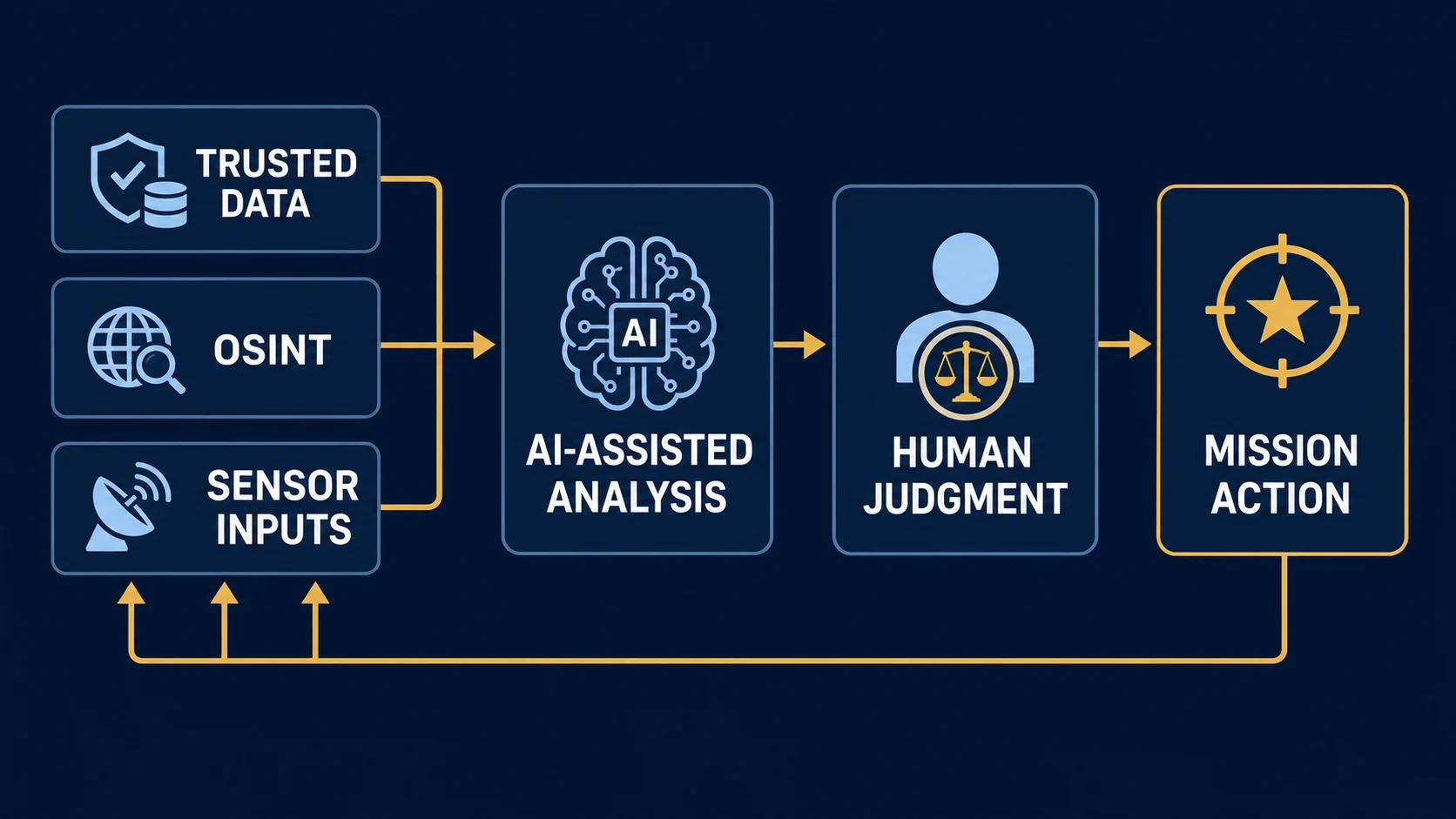
The tactical edge is not defined only by geography. It is any environment where time is compressed, communications are uncertain, evidence is incomplete, and the cost of a poor decision is high. In that setting, adding another dashboard rarely creates advantage. The more important design problem is building a dependable chain from observation to judgment to action.
Decision advantage is a system property
The Department of Defense's Data, Analytics, and Artificial Intelligence Adoption Strategy frames AI around enduring decision advantage rather than isolated demonstrations. That distinction matters. A model may be accurate in a laboratory and still fail operationally when data is late, provenance is unclear, interfaces overload the operator, or communications disappear. Advantage belongs to the complete sociotechnical system: people, procedures, data, software, networks, and authorities.
Build from evidence, not output
Open-source reporting, organic sensors, partner data, and historical context should enter a common evidence layer with timestamps, provenance, confidence, and handling rules. The IC OSINT Strategy 2024–2026 emphasizes professionalized tradecraft, coordinated acquisition, innovation, and an integrated workforce. Those priorities are especially relevant at the edge, where an attractive answer without traceable evidence can become a liability.
Use AI to organize uncertainty
AI is most valuable when it reduces search costs, surfaces relevant patterns, compares plausible explanations, and shows what would change an assessment. The NIST AI RMF Core organizes risk work around govern, map, measure, and manage. For an operational team, that means defining the decision, measuring system performance under realistic conditions, exposing uncertainty, and maintaining a record of how recommendations were produced.
Design graceful degradation
Edge systems must continue to support the mission when bandwidth falls, a feed becomes unavailable, or a model cannot be reached. Local caches, compact data products, interoperable formats, and explicit fallback modes are therefore mission features—not merely infrastructure details. GAO reporting on joint battle management underscores the persistent challenge of defining scope and interoperability across command-and-control efforts. Resilience begins with clear interfaces and responsibilities.
Keep authority unmistakably human
Human judgment should not be reduced to approving a machine-generated conclusion. Decision-makers need time, context, alternatives, and the ability to challenge assumptions. DARPA's Air Combat Evolution program illustrates a hierarchical approach: autonomy handles bounded tactical behaviors while people retain higher-order mission responsibilities. The broader lesson is that teams perform best when authority, automation boundaries, and handoff conditions are designed before the crisis.
Operational takeaways
- Unify evidence and provenance before adding automation.
- Make uncertainty and alternative explanations visible.
- Design for disconnected, degraded, and low-bandwidth operation.
- Define human authority and machine boundaries in advance.
Research sources
This analysis draws on the following authoritative public sources:
- U.S. Department of Defense — Data, Analytics, and AI Adoption Strategy
- ODNI — IC OSINT Strategy 2024–2026
- NIST — AI Risk Management Framework Core
- GAO — Joint Battle Management
- DARPA — Air Combat Evolution
National Defense Lab publishes independent analysis for educational and capability-development purposes. This article does not disclose classified information or represent official U.S. government policy.