
Within a matter of days, Americans watched a nationwide aviation ground stop, a major bank's payment disruption, and new reports of compromises affecting government information systems. The incidents did not share one proven cause. Some were technical failures. Others remain under investigation. That distinction is important, because responsible analysis should never turn coincidence into a claim of coordination.
But different causes can expose the same vulnerability. Aviation, finance, communications, energy, public safety, and government operations now depend on dense networks of software, data, identity services, telecommunications, vendors, and aging physical infrastructure. When one component becomes unstable, the consequence can move far beyond the machine that failed.
This is the national issue: a system does not have to be attacked to produce strategic disruption. It only has to be essential, interconnected, and unable to degrade gracefully.
A failure does not need to be hostile to become strategic
Cybersecurity asks whether an adversary can gain access, manipulate data, interrupt service, or cause damage. Operational resilience asks a different question: can the mission continue when prevention fails—or when the disruption was never malicious in the first place?
That difference was visible in the recent banking incident. According to reporting by The Associated Press, Chase attributed delayed deposits and other customer problems to a software bug involving on-premises hardware, not a cyberattack. The origin was technical. The public consequence was operational: people could not reliably access expected financial services, and uncertainty spread faster than verified information.
For national preparedness, the correct lesson is not that every outage is an attack. It is that hostile action, equipment failure, flawed software, human error, supplier disruption, and extreme weather can all arrive at the same operational endpoint. Resilient institutions plan around consequences as seriously as they plan around causes.
The FAA event made systemic fragility visible
The Federal Aviation Administration's account of the November 13 nationwide ground stop is unusually instructive. The agency said legacy equipment became unstable when data flooded the FAA Telecommunications Infrastructure network, generating approximately 1,000 connection attempts every four to five seconds. Controllers could still communicate with aircraft, but the FAA halted departures as a safety precaution while technicians stabilized the system.
The FAA reported 12,462 canceled flights that Friday, while cautioning that not every cancellation was directly caused by the ground stop. That qualification matters. So does the scale. A technical problem inside a safety-critical network quickly affected airlines, airports, crews, passengers, cargo schedules, and confidence across the national airspace system.
The event also reinforces a longer-running concern. A 2026 Government Accountability Office review found that controllers rely on legacy systems to manage as many as 45,000 flights a day and warned that the FAA's modernization effort needs disciplined cost, schedule, and performance planning. Modernization is not simply an information-technology upgrade. It is national infrastructure risk reduction.
Security and resilience solve different parts of the problem
The National Institute of Standards and Technology defines cyber resilience around four verbs: anticipate, withstand, recover, and adapt. That sequence recognizes an uncomfortable reality. Defenders cannot guarantee that every component, vendor, credential, or communication path will remain available and trustworthy at all times.
A secure system tries to prevent compromise. A resilient system assumes disruption will still occur and is designed to preserve essential functions through it. National systems need both.
That design discipline begins with a deceptively simple question: what is the minimum viable mission? For air traffic, it may mean maintaining safe separation and trusted controller-pilot communications while nonessential services are reduced. For a bank, it may mean preserving customer access, transaction integrity, and clear status information even when a primary platform fails. For emergency management, it may mean keeping verified alerts and dispatch coordination functioning across multiple communications channels.
The real attack surface is dependency
Organizations usually inventory their own hardware and software. Fewer can produce an accurate map of the services their mission depends on across telecommunications, cloud platforms, identity providers, payment processors, data vendors, logistics networks, and specialized contractors.
The Federal Reserve's operational resilience guidance explicitly addresses interdependency, interconnectivity, scale, complexity, third-party dependence, and severe-but-plausible scenarios. Its third-party risk guidance likewise calls attention to concentration risk, telecommunications redundancy, disaster recovery, and business continuity.
These are not banking concerns alone. The same logic applies anywhere a single provider, protocol, routing path, dataset, or identity service can quietly become a national point of failure. Efficiency encourages consolidation. Resilience requires leaders to understand where consolidation has removed meaningful alternatives.
An outage also creates an information environment
When essential systems fail, the technical incident is only half the event. The other half unfolds in public perception. Users see failed transactions, grounded flights, inaccessible portals, or contradictory messages before institutions have completed diagnosis. In that gap, speculation hardens into narrative.
This is why information resilience belongs inside continuity planning. Organizations need preapproved communication paths, visible evidence, clear uncertainty language, and a trusted cadence of updates. Silence can turn an ordinary defect into a perceived attack. Premature certainty can destroy credibility if the facts change.
Open-source intelligence can help leaders distinguish verified indicators from noise, understand how disruption is being described across communities, and identify coordinated exploitation of a real event. The goal is not to suppress public concern. It is to keep decisions anchored to evidence while the operating picture develops.
Mission continuity by design
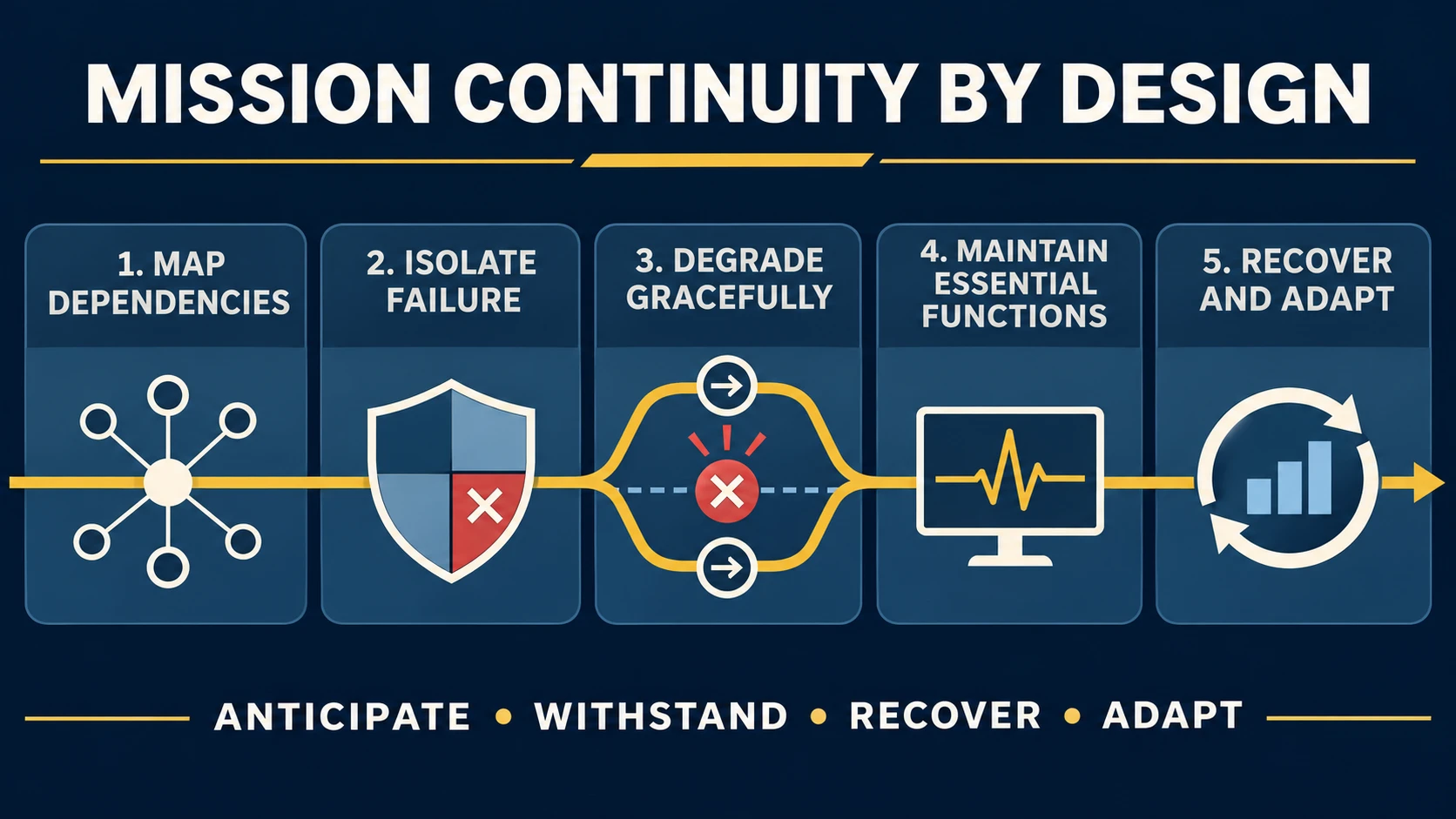
Resilience cannot be added after an outage. It must be designed into architecture, operating procedures, procurement, training, and exercises. Five practices deserve priority.
- Map mission dependencies. Identify which people, data, communications, suppliers, facilities, and authorities each essential function requires. Follow dependencies beyond the first vendor.
- Isolate failure. Segment systems and decision rights so one unstable component cannot consume the entire operation. Build containment around data, networks, access, and physical processes.
- Degrade gracefully. Define which functions can slow, simplify, or stop while safety and core service continue. A fallback should be an engineered operating mode, not an improvised emergency.
- Maintain essential functions. Preserve trusted communications, human authority, verified data, and the minimum tools required to execute the mission. This is where disciplined human-machine teaming matters: people must understand what automation knows, what it does not know, and when to intervene.
- Recover and adapt. Restore services in a controlled sequence, validate integrity, capture evidence, and change the system based on what the incident revealed.
Exercises should test more than restoration time. They should force teams to operate with missing data, unreliable automation, degraded communications, supplier outages, and deliberate misinformation. The measure of preparedness is not whether the normal dashboard returns. It is whether the organization can still make defensible decisions before it does.
What national leaders should demand now
Executives, program managers, regulators, and infrastructure operators should be able to answer six questions without waiting for a crisis:
- Which national or organizational missions are truly essential?
- What hidden dependencies can stop those missions?
- Which failures can be isolated, and which will cascade?
- What does safe degraded operation look like?
- Who retains decision authority when automation or data becomes unreliable?
- What evidence will tell the public, partners, and operators what is known, unknown, and changing?
The answers should be demonstrated, not assumed. Resilience is an operational property that emerges through architecture, rehearsal, observation, and adaptation.
Why National Defense Lab exists
National Defense Lab exists to help close the space between recognizing systemic risk and building a capability that can withstand it. As an independent civil defense venture studio, NDL brings research, design, open-source intelligence, artificial intelligence, information resilience, emergency preparedness, and human-centered systems thinking into one problem-solving environment.
Projects such as CDEAMS reflect that mission: connect agencies, responders, and communities around trusted emergency information rather than assuming one channel or platform will always be available. Across domains, the objective is the same—turn complex dependencies into understandable decisions, test systems under realistic pressure, and build continuity before disruption removes the time to improvise.
The latest outages should not be collapsed into one frightening story. They should be read as a pattern of consequences. America has extraordinary technology and deeply capable institutions. But a connected nation is only as prepared as its ability to keep essential missions operating when connection becomes the problem.
Preparedness means designing systems that can fail without failing the nation.
Research sources
This analysis draws on the following authoritative and independently reported public sources:
- Federal Aviation Administration — Nationwide Ground Stop: Questions and Answers
- U.S. Government Accountability Office — Air Traffic Control Modernization
- Cybersecurity and Infrastructure Security Agency — Infrastructure Resilience Planning Framework Playbook
- National Institute of Standards and Technology — Developing Cyber-Resilient Systems
- Federal Reserve — Sound Practices to Strengthen Operational Resilience
- Federal Reserve — Interagency Guidance on Third-Party Relationships
- The Associated Press — Chase says software bug caused banking disruption
National Defense Lab is an independent civil defense venture studio. This analysis is based exclusively on publicly available information, does not disclose classified information, and does not represent official U.S. government policy.